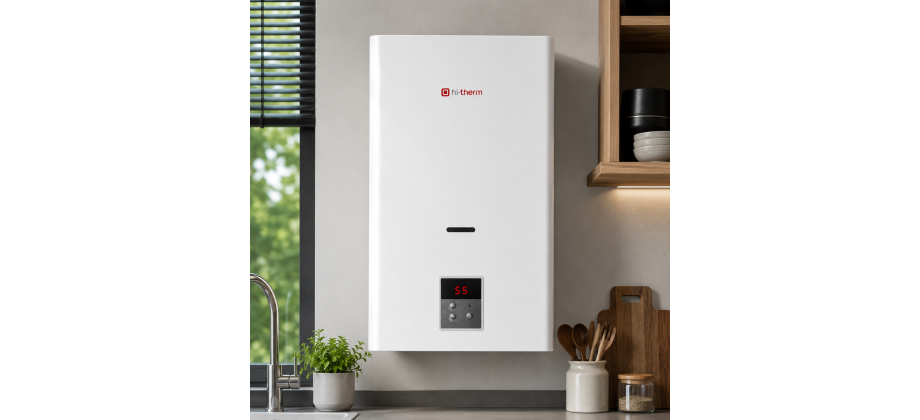
A gas water heater is one of the most practical ways to provide hot water where natural gas is available. Modern instant gas water heaters are compact, economical, fast in operation, and do not require a storage tank.
Unlike an electric storage boiler, a gas water heater heats water directly as it flows through the heat exchanger. This means the user is not limited by tank capacity and does not need to wait for the next heating cycle after hot water has been used.
The main advantage of a gas water heater is instant water heating, compact size, and economical operation during everyday use.
The operating principle of an instant gas water heater is quite simple. When the user opens the hot water tap, the flow sensor detects water movement and automatically starts the burner. The flame heats the heat exchanger, water passes through it, and within a few seconds hot water reaches the tap.
This is why a gas water heater does not waste energy constantly maintaining the temperature of a large volume of water, as happens in storage-type water heaters.
An electric boiler stores water in a tank and gradually heats it to the selected temperature. When the hot water reserve is used up, a new heating cycle is required.
A gas water heater works differently: it heats water directly during use. This is convenient for families where hot water is used frequently or by several people in a row.
| Parameter | Gas Water Heater | Electric Boiler |
|---|---|---|
| Operating principle | Heats water during flow | Stores and heats water in a tank |
| Hot water volume | Practically unlimited | Limited by tank volume |
| Dimensions | Compact | Depends on tank capacity |
| Waiting time | Minimal | Heating time is required |
The capacity of a gas water heater shows how many liters of water it can heat in one minute at a certain temperature difference. Values such as 10 L/min or 11 L/min help determine what type of use the appliance is suitable for.
The higher the capacity, the more hot water the heater can prepare per unit of time. However, the choice should take into account the number of users, water consumption points, and water pressure in the system.
Modern gas water heaters are usually equipped with automatic electronic ignition. This means the burner starts automatically after the hot water tap is opened.
This solution is more convenient and economical than older systems with a constantly burning pilot flame. Many models operate on batteries and do not require connection to the electrical grid, which is especially useful for everyday reliability.
The heat exchanger is one of the most important components of a gas water heater. It transfers heat from the burner to the water.
Copper is considered one of the best materials for heat exchangers due to its high thermal conductivity, fast heating, and long service life. An additional protective coating helps improve corrosion resistance and extend the lifespan of the equipment.
During hot water use, system pressure may change. For example, another tap may be opened or the water flow may fluctuate. In basic models, this can lead to temperature variations.
Flame modulation allows the heater to automatically adjust burner intensity according to water flow. As a result, the temperature remains more stable and showering becomes more comfortable.
If water pressure often changes in the home, it is worth considering models with flame modulation. This increases daily comfort.
Safety is one of the key criteria when choosing a gas water heater. A quality instant water heater should include a set of protective systems that monitor operation and automatically stop gas supply in unsafe situations.
These functions make modern gas water heaters significantly safer and more convenient for daily operation.
A gas water heater is purchased for many years, so energy efficiency matters. Models with Class A energy efficiency help use gas more effectively, reducing operating costs without loss of performance.
High energy efficiency is achieved through a well-designed burner, a quality heat exchanger, and stable heating system operation.
Before choosing a gas water heater, it is important to consider not only the price, but also the technical characteristics, installation conditions, and further service support.
Many modern models operate on batteries and do not require connection to the electrical grid. This is convenient for apartments and houses where independence from electricity is important.
For most apartments, a capacity of 10–11 L/min is sufficient. The final choice depends on the number of users, water consumption points, and desired comfort level.
The main reason is fluctuation in water pressure or flow. Models with flame modulation maintain a more stable temperature during use.
Copper has high thermal conductivity, transfers heat to water quickly, and supports efficient long-term operation of the water heater.
A gas water heater remains one of the most efficient ways to provide hot water where natural gas is available. Modern instant water heaters combine compact dimensions, fast water heating, economical operation, and a high level of safety.
When choosing a gas water heater, it is important to consider capacity, ignition type, heat exchanger material, safety systems, energy efficiency class, and service support. A comprehensive approach will help select equipment that works reliably for many years and provides daily comfort in the home.


