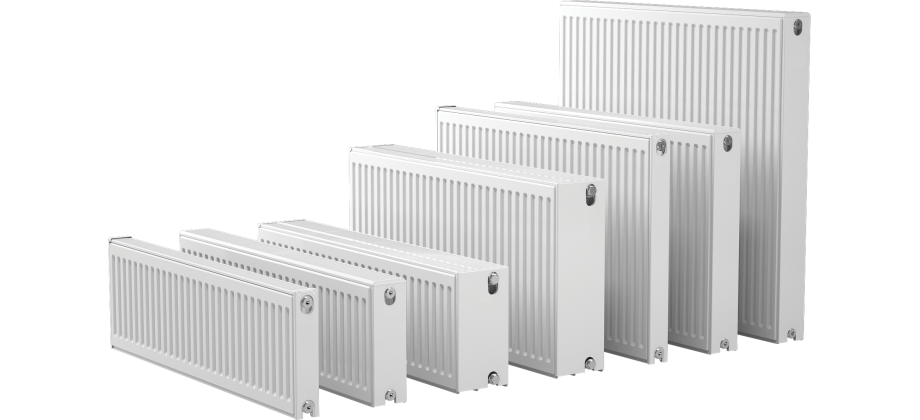
Proper selection of a heating radiator directly affects the energy efficiency of the heating system, indoor comfort level, energy consumption, and equipment lifespan. When choosing a radiator, it is important to consider not only design and cost, but also key technical parameters of the heating system: coolant type, operating pressure, temperature regime, room heat loss, and installation specifics.
In this article, we will review the main types of heating radiators, their technical characteristics, and the key criteria for professional radiator selection.
Steel panel radiators are one of the most popular solutions for autonomous heating systems due to their optimal balance of cost, heat output, and energy efficiency.
A radiator consists of one or several steel panels with internal channels for coolant circulation. Convection fins are used to increase heat output.
The most common types:
Type 11 — one panel + one convector;
Type 22 — two panels + two convectors;
Type 33 — three panels + three convectors.
high heat output;
fast room heating;
low water volume;
energy-efficient operation with modern boilers and heat pumps;
wide range of sizes;
modern minimalist design.
sensitivity to coolant quality;
limited resistance to hydraulic shocks in some central heating systems.
private houses;
apartments with individual heating;
low-temperature systems;
heat pump systems.
Bimetal radiators are specifically designed for operation in central heating systems with high operating pressure and possible water hammer.
The inner collector is made of steel, while the outer part is made of aluminum, combining mechanical strength and high heat transfer.
resistance to high pressure;
high resistance to hydraulic shocks;
long service life;
high thermal output;
compatibility with central heating systems.
higher cost;
lower thermal inertia compared to steel panel radiators.
apartment buildings;
centralized heating systems;
systems with unstable coolant quality.
Aluminum radiators are characterized by high heat output and minimal thermal inertia.
high heat output;
lightweight design;
fast heating;
modern appearance;
easy installation.
higher requirements for coolant quality;
sensitivity to pressure fluctuations;
risk of electrochemical corrosion if improperly operated.
autonomous heating systems;
private houses;
low-temperature systems.
Cast iron radiators have high thermal inertia and strong resistance to aggressive coolant.
durability;
corrosion resistance;
stable operation in old heating systems;
long heat retention after shutdown.
heavy weight;
high thermal inertia;
difficult installation;
slow response to temperature control.
The main parameter when selecting a radiator is the required heating power of the room.
Basic guideline for standard rooms:
Q = S × 100 W
Where:
Q — required heating power;
S — room area.
For rooms with high ceilings, panoramic windows, or poor insulation, correction factors must be applied.
Professional selection must consider:
building heat loss;
system temperature curve;
climate zone;
glazing area;
insulation quality.
For central heating systems, it is especially important to consider both operating and test pressure.
Recommended values:
autonomous systems: 2–4 bar;
central heating: 6–10 bar and higher.
In case of possible water hammer, radiators with increased safety margin are recommended.
Modern energy-efficient systems increasingly operate in low-temperature modes:
55/45°C or 45/35°C
Therefore, radiator efficiency at low coolant temperatures must be considered.
Steel panel radiators perform very well when used with:
condensing boilers;
heat pumps;
weather-compensated automation.
Main connection options:
A classic solution for most heating systems.
Used in modern interiors with hidden pipework.
Advantages:
aesthetic appearance;
concealed installation;
compatibility with thermostatic valves.
The thicker the metal:
the longer the service life;
the higher corrosion resistance;
the better mechanical strength.
High-quality powder coating protects against:
corrosion;
mechanical damage;
color fading.
Thermostatic control enables:
stable temperature maintenance;
reduced energy consumption;
improved comfort.
Recommended:
bimetal radiators;
reinforced steel radiators with high pressure rating.
Most efficient options:
steel panel radiators;
aluminum radiators.
Especially when used with:
condensing boilers;
heat pumps;
low-temperature heating systems.
Radiator selection should be based on proper system calculations rather than appearance or price alone.
Key factors include:
heating system type;
operating pressure;
heating capacity;
temperature regime;
coolant quality;
energy efficiency.
A properly selected radiator ensures:
uniform room heating;
lower energy consumption;
long heating system lifespan.


